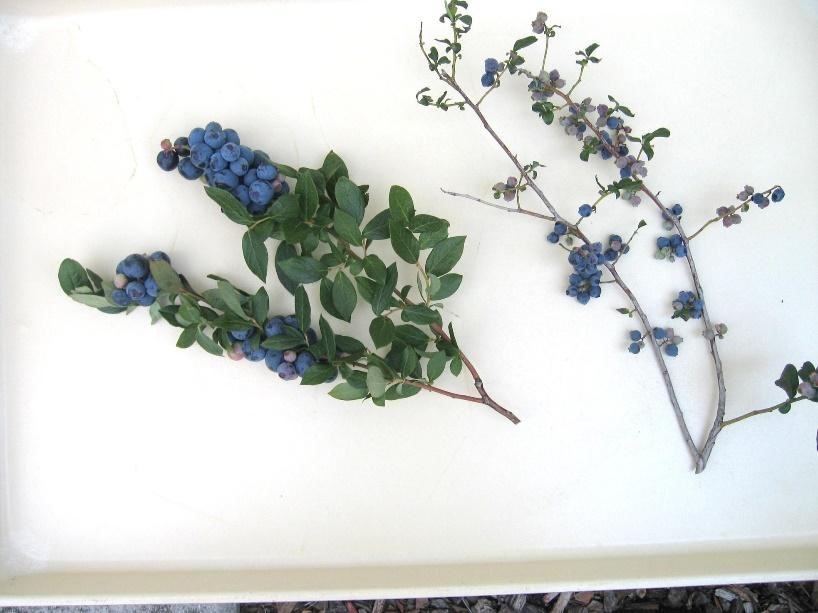
Blueberries are a great plant to have in the home garden. Not only are blueberries great for their tasty fruit during the summer months, but they can make a nice hedge or screen in the landscape. Besides fruit in the summer, blueberries have attractive white or pink flowers in the spring and wonderful red to yellow foliage in the fall. Now that we are in late winter with spring just around the corner, it is time to prune blueberry bushes before the new growth begins.
When pruning blueberry bushes, you should prune so the bush has a narrow base and is open in the center. While pruning, remember to take a step back occasionally to make visual observations of the plant to avoid getting too carried away while pruning. Most of the smaller stems and canes can be pruned with hand pruners, while for your larger sized stems you will need to use a pair of loppers or a pruning saw.
Of course the main objective when pruning blueberry bushes is to increase fruit production. The first step that should be taken when you begin pruning is to take out any dead canes. These canes are not producing any fruit and provide a great location for pests to enter into the plant. Dead or dying stems will be light gray in color, while healthy, living stems will be brown in color.
Over time blueberry bushes will form many root suckers, which are stems that come out of the ground from the roots. On mature bushes, many of these root suckers will be away from the center of the bush. You want to prune out these root suckers, especially the ones that are away from the base of the plant. It is okay and maybe even desirable to keep a few root suckers that have come up within the base of the bushes. The root suckers within the base of the plant will be new growth that will replace older canes over time.
The center of the blueberry bush should be thinned to allow for sunlight and good air circulation throughout the plant. Remove older canes that will help open up the center of the bush. Along with thinning the bush, be sure to prune out any stems that are touching or crossing each other. When selecting what to keep or prune out, keep in mind that thin, twiggy or “matchstick” wood will result in small berries. Keep pencil size or larger wood to have larger blueberries.