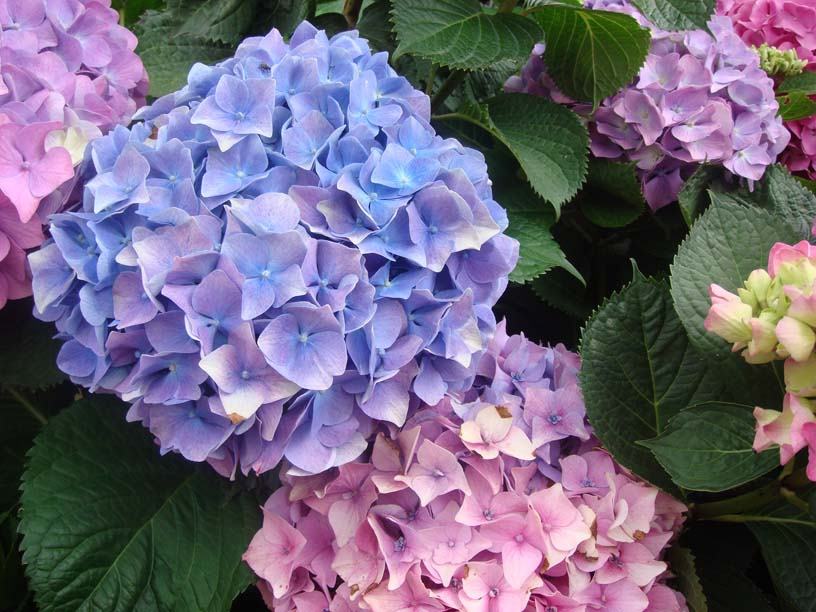
Hydrangeas are a popular flowering shrub in the landscape with showy flowers in late spring through early summer. Hydrangeas provide a large burst of color in the landscape with their large flower clusters. You will often see a variation of colors on hydrangeas from blue to pink. It is possible to change the color of some types of hydrangeas based on the soil pH.
There are many types of hydrangeas, but the ones you can change the flower color on are the types usually referred to as mopheads, lacecaps, bigleaf, or French hydrangeas. There are other types of hydrangeas, such as oakleaf and PeeGees that have white- or cream-colored flowers which you cannot change the flower color of.
The type of hydrangeas you can change the flower color on is determined indirectly by the soil pH. It is the availability of aluminum to the plant that determines the flower color but changing the soil pH will dictate whether aluminum is available to the plant or not.
For a hydrangea with blue flowers, the soil pH should be acidic with a pH between 5 and 5.5. Acidic soil allows aluminum to be available to the plant and results in blue flowers. A soil pH of 6 or more will cause aluminum in the soil to not be available to the plant and results in a hydrangea with pink flowers. Many times, you see hydrangeas with pink, blue, and purple all on one plant. This is usually because the soil pH is somewhere in the middle (5.5 to 6) so you get flower colors in between blue and pink.
So, if you decide that you want to change the color of your hydrangea you will have to change the soil pH. The first step would be to know what your current soil pH is. The best way to determine this is to get a soil test. Soil test boxes and forms are available at the Wayne County Extension Office at 3114-B Wayne Memorial Drive, Goldsboro. Once you get your soil test results back, you will know what the soil pH is and whether you need to increase or decrease it to get your desired flower color. To increase soil pH, you will need to add lime to the soil. To decrease soil pH, you will need to add sulfur to the soil.
Many soils in North Carolina are acidic (low soil pH), so most people will probably have a hydrangea with blue flowers. Unfortunately, it can take a while for the effects of changing the soil pH to show up in the flower color. Some materials, like lime, will take several months before changing the soil pH. If you must make dramatic changes in the soil pH to alter the hydrangea's flower color, it can become quite difficult. Even if you do reach the desired soil pH, the soil will naturally revert to its original soil pH. So, it could be a battle to not only change the soil pH but to also maintain that soil pH. If you do change the soil pH, you would want to get a soil test every year or so to monitor changes in the soil pH over time so you would know when you need to apply more material. Note that you do not want to change the soil pH to rapidly or it could lead to some browning of the foliage.
You might not have realized that you could have a science experiment in your own garden but with a little knowledge of soil pH and patience, the bigleaf hydrangea is the only plant you can have some fun with manipulating the flower color.
Jessica Strickland is an agriculture extension agent, specializing in horticulture for North Carolina Cooperative Extension in Wayne County.
Learn More!